Product evidence
Capture product pages with price, availability, claims, and source context intact
Product research depends on public evidence scattered across product pages, marketplace listings, category pages, reviews, pricing pages, documentation, changelogs, and launch pages. ScraperFly helps teams capture those sources in practical formats before they invest in normalization, enrichment, or recurring monitoring.
The value is not just fetching a URL. A useful product record should explain where it came from, when it was captured, which variant or seller state was visible, which response format was used, and whether rendering or visual proof changed the result. That context keeps research work grounded when sources, categories, and cadence are still changing.

What is web scraping for product research?
Web scraping for product research means capturing public product-related pages so teams can study markets, categories, competitors, assortment, pricing, product claims, reviews, availability, and catalog structure. The sources can include product detail pages, marketplace listings, category pages, brand pages, store pages, review pages, product documentation, comparison pages, and launch announcements.
ScraperFly fits as the capture layer. It retrieves the public page and returns HTML, rendered HTML, text, Markdown, metadata, screenshots, or PDFs depending on what the workflow needs. The downstream product system can then extract fields, normalize attributes, merge duplicate records, map categories, score product opportunities, or route samples for review.
This separation matters. ScraperFly does not pretend every product source has the same schema or that every page becomes a clean catalog automatically. It gives teams reliable source capture and response evidence so product research can start with real page behavior instead of brittle assumptions.
Practical takeaway: use product scraping to preserve public source evidence first, then normalize and compare records in the system that understands your product model.
Which product sources are worth capturing?
The best product research workflows start with a source map. Product detail pages reveal title, brand, SKU, variant, price, availability, images, description, specifications, ratings, and seller context. Category pages reveal assortment, positioning, ranking, filters, and pagination. Marketplace listings reveal sellers, stock state, competing offers, shipping hints, and promotion language. Review pages can add public reputation context, while documentation and changelogs can expose product capabilities and release movement.
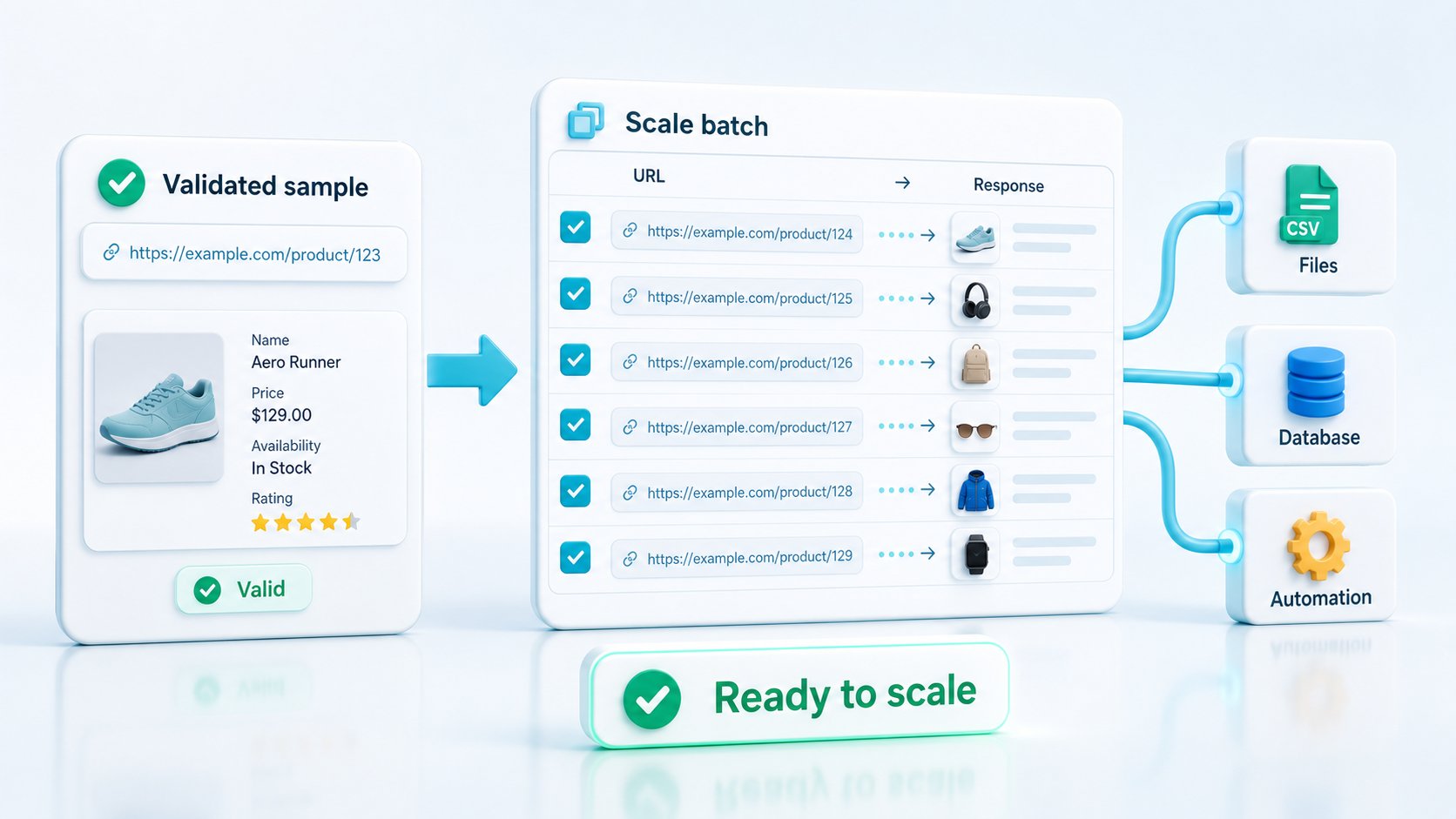
Do not scale every source at once. Test a small group of representative product, category, and marketplace pages. Compare source HTML with rendered output. Check whether fields appear consistently. Verify whether price and availability vary by region, seller, cookie state, or variant selection. Then turn only the proven source types into recurring capture.
| Source type | Useful evidence | Common risk | Best capture choice |
|---|---|---|---|
| Product detail pages | Title, brand, SKU, price, images, specs, availability | Variants, JavaScript, regional offers, seller changes | HTML or rendered HTML with metadata |
| Category pages | Assortment, filters, ranking, pagination, product cards | Dynamic sorting, sponsored placements, duplicate products | HTML, Markdown, screenshot samples |
| Marketplace listings | Seller, price, stock state, shipping hints, offer context | Personalization, regional availability, anti-bot behavior | Rendered capture, routing evidence, proof samples |
| Review pages | Rating, review count, public snippets, themes | Pagination, login prompts, frequently changing counts | Text, Markdown, metadata, selected screenshots |
| Docs and launch pages | Feature claims, release notes, specs, positioning language | Template noise, dynamic sections, changed docs paths | Markdown or text with source metadata |
Which product fields should teams define first?
A product research schema should be specific enough to support a decision. Common fields include product title, brand, SKU or model, category, variant, seller, price, currency, discount, stock state, image URL, description, specifications, rating, review count, source URL, final URL, timestamp, response status, and output format. For sensitive records, a screenshot can preserve visible proof of the product state.
The exact schema depends on the job. Assortment research may care about category, brand, and product family. Pricing checks need currency, seller, variant, and promotion context. Catalog enrichment may need specifications and images. Product discovery may need descriptions, claims, reviews, and comparison text. Monitoring needs timestamps and enough source context to explain why a field changed.
| Field group | Examples | Why it matters | Capture note |
|---|---|---|---|
| Identity | Title, brand, SKU, model, category, source URL | Helps match product records across sources. | Keep final URL and timestamp for traceability. |
| Commercial state | Price, currency, discount, stock, seller, shipping hint | Supports pricing checks and offer comparison. | Preserve variant and regional context. |
| Product detail | Description, specs, images, compatibility, feature claims | Supports catalog enrichment and product discovery. | Use HTML for structured fields or Markdown for review. |
| Reputation | Rating, review count, public snippets | Adds market context without replacing analysis. | Keep source evidence and avoid treating snippets as full sentiment. |
| Proof | Screenshot, PDF, response metadata, capture settings | Makes high-value samples easier to audit. | Use for QA and important changed records. |
When do product pages need rendering or stronger delivery?
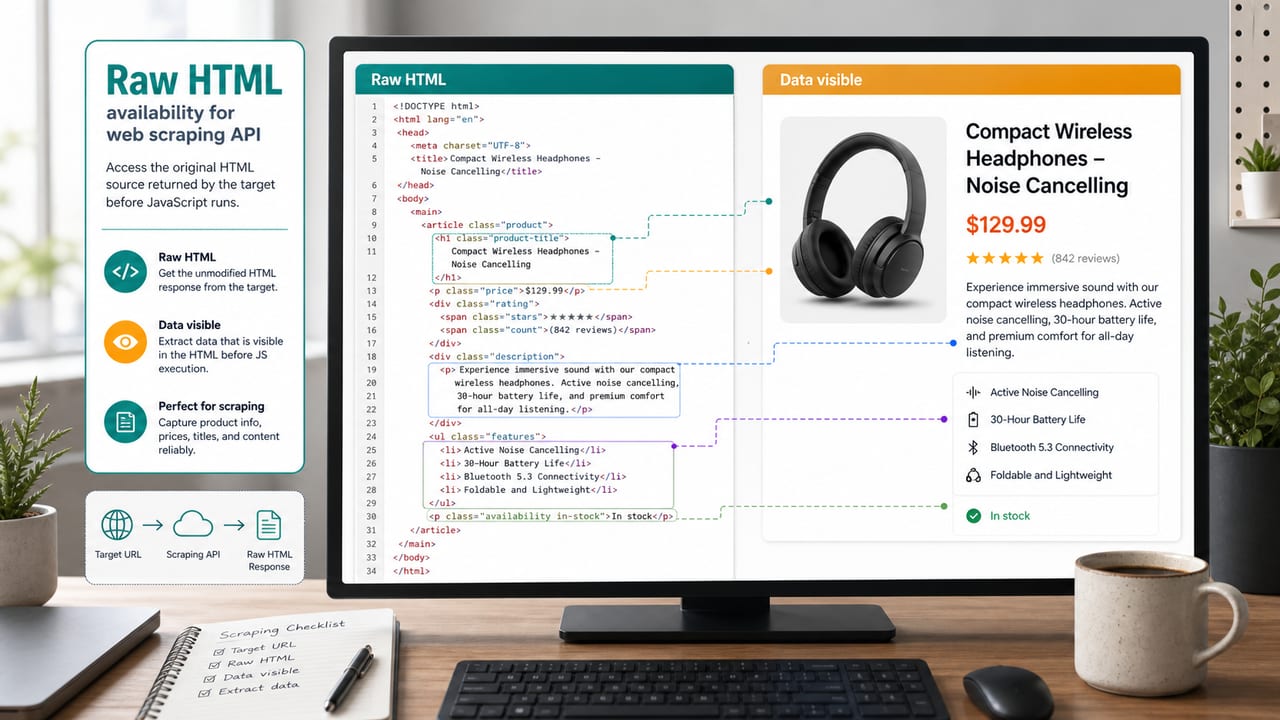
Many product pages include useful fields in source HTML. Those pages can stay lightweight. Other pages build price, stock state, variants, reviews, image galleries, recommendations, or product cards after JavaScript runs. Rendering is useful when it changes the evidence that the product workflow needs. Wait timing is useful when content appears late. Stronger delivery or regional routing is useful when the page returns incomplete, blocked, or market-specific content.
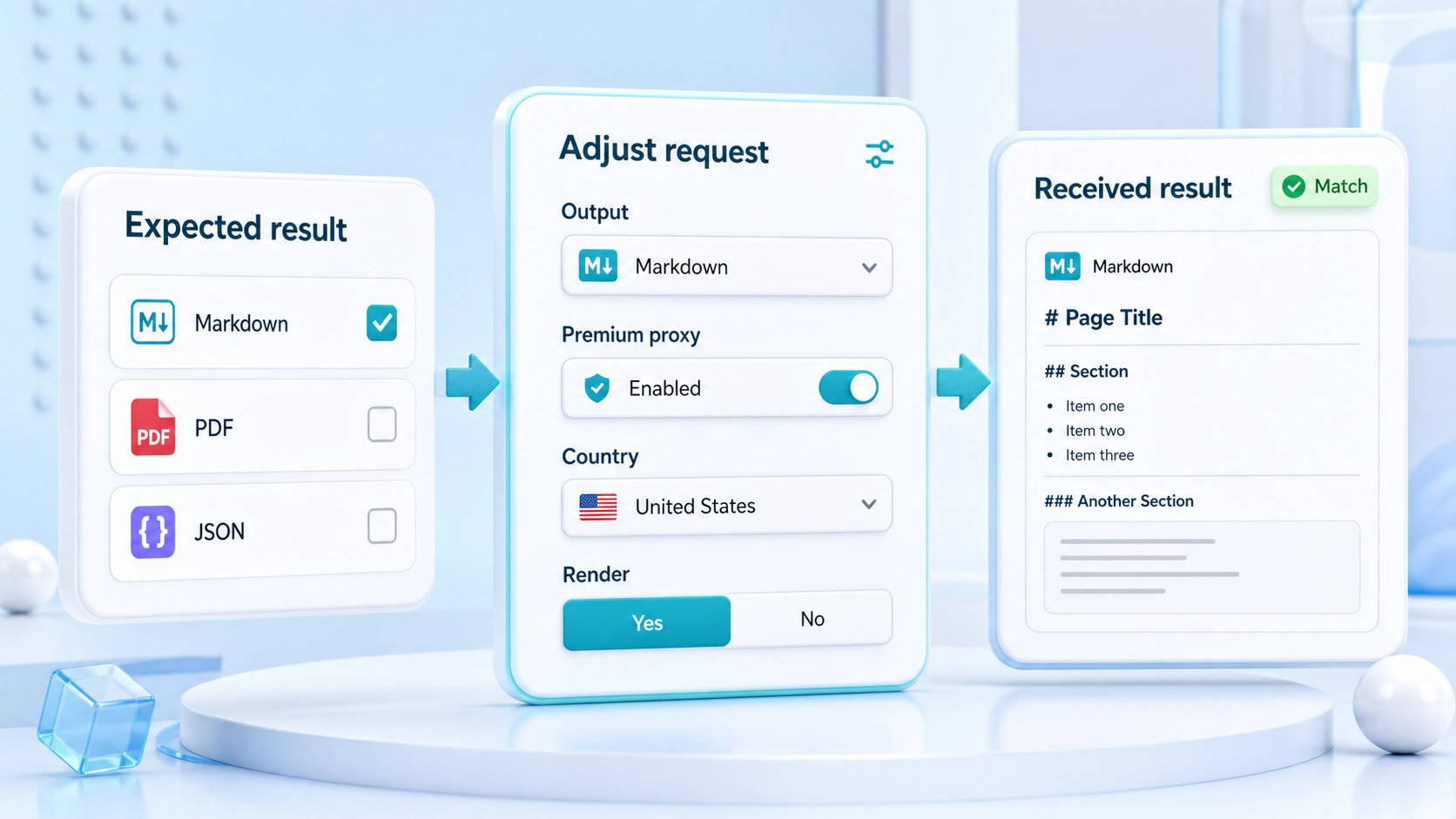
The best path is evidence-based. Capture source HTML first, compare rendered output on representative samples, inspect final URL and response size, then decide whether rendering, waits, headers, sessions, country targeting, or premium routing should be part of that source profile. The JavaScript rendering API, country targeting, and response formats pages help teams make those choices deliberately.
Practical takeaway: keep simple product sources light and reserve heavier controls for pages where samples prove they improve field quality.
How should teams handle product data quality?
Product data gets messy quickly. The same product may appear under different names, sellers, currencies, categories, or variants. A listing may show a discount in one region and full price in another. Review counts change. Images rotate. Product specs can be hidden behind tabs. A category page may include sponsored products or personalization. The capture layer should preserve enough evidence for the downstream system to normalize those differences.
ScraperFly helps by making source capture repeatable and inspectable. Preserve source URL, final URL, status, content type, response size, timestamp, output format, and proof artifacts when needed. Then use your product model to dedupe, map categories, clean attributes, merge seller offers, and decide which fields are reliable enough for analysis or automation.
How can product research scraping stay affordable?
Product research often starts exploratory: a category, a competitor, a marketplace, a few product families, a handful of regions. It should not require a large fixed subscription before the source quality is proven. Start with free credits, test representative pages, buy pay-as-you-go credits for uneven research, and move recurring collection to monthly credits only when the source cadence and request profile are clear.
Request weight matters too. HTML, text, and Markdown can cover many research pages. Rendering, waits, screenshots, country routing, sessions, and premium delivery belong on sources where they improve the captured evidence. The credit cost calculator and pricing page help estimate the impact before expanding categories or marketplaces.
Why use ScraperFly for product research?
ScraperFly gives product, growth, data, and research teams one API layer for public product source capture. It can return raw HTML for extraction, rendered HTML when JavaScript matters, text or Markdown for review, metadata for logging, and screenshots or PDFs for visual proof. It also keeps delivery controls explicit, so teams can choose sessions, headers, country targeting, waits, or premium routing only when evidence supports the heavier request.
That makes product research easier to start and safer to scale. Teams can test sources cheaply, preserve source context, compare response formats, and turn proven pages into recurring workflows without building fragile fetch, render, proxy, screenshot, and cleanup infrastructure first.